A continuity is a function that is continuous at every point of its domain. What this means is that it is predictable, has no breaks, and has no jumps. The picture below is an example of a continuity.

What is a discontinuity?
A discontinuity is a part of a function that makes it break or jump. There are 3 type of discontinuities which can be dealt with. There are jump discontinuities, infinitediscontinuities, and oscillating discontinuities.
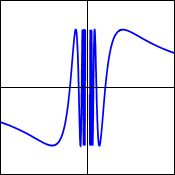
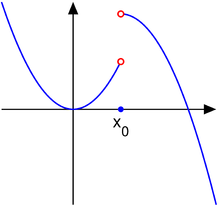
2. What is a limit? When does a limit exist? When does a limit not exist? What is the difference between a limit and a value?
A limit is the intended height of a function. This will exist when you reach the same height from both the left and right. This will require for the right hand limit notation and left hand limit notation be the same. A limit does not exist if there is a break at a given x-value. The difference between a limit and a value is that the limit is the intended height of the function while the value is the actual height we reach of the function.
Example Below:

3. How do we evaluate limits numerically, graphically, and algebraically?
We are able to evaluate limits algebraically when we find the 3 limit from the left and from the right of the value we are given. This usually requires creating a table on which we record our answers. To evaluate graphically we will have to input our equation into the graphing calculator or look at the given graphs to see where the value of points are at. To solve algebraically would require the direct substitution of values in order to find the limit and if that is not enough it would require other methods such as factoring and rationalizing.


No comments:
Post a Comment